Fulvic Acids Application in Agriculture
What is Fulvic Acid?
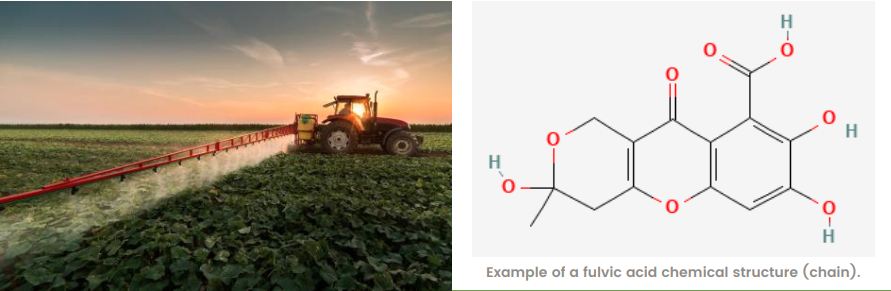
- Fulvic acid is a naturally occurring humic substance that is extracted from raw humalite or Leonardite. They present a lower molecular weight (1000 Da) and a higher oxygen content, compared to those in humic acids, containing carbon chains and functional groups in the structure.
- The lower molecular size and weight in fulvic acids are easily taken up by plants’ roots, stems, and leaves. The higher content of free oxygen chains accompanied by carboxylic groups allows them to be more reactive and to have great chelating capabilities. Allowing fulvic acids to act as a carrier of trace minerals and substances.
- Fulvic Acids are the best-known natural non-toxic chelating compound available.
- Fulvic Acids are soluble in water under all pH conditions and remain in solution after the removal of humic acids by acidification. Therefore, they can safely be added to a wide range of foliar and irrigation fertilization programs, as well as to other agricultural inputs applications, increasing their uptake and efficiency.
To explain how fulvic acids improve micronutrient uptake, please refer to the example below.
How Fulvic Acids chelated Iron (Fe), improving its uptake by the plant.
Current research shows that Fe (EDDHA) and similar chelates, despite their high stability, are not perfect. While they can provide ample iron delivery and can assist Fe deficiencies in most cases for these plants, these strong chelates are often very expensive and their use as sole Fe sources might be impractical in traditional agriculture. The use of humic/fulvic acids complemented with either unchelated Fe or with some lower proportion of stronger iron chelates, is a better overall choice in terms of both plant uptake and economic expense.
The effect of fulvic acids and synthetic chelates is synergistic, with both providing advantages that can be complementary. These fulvic acid solutions might also be more favorable for plant species, where the use of highly stable Fe (EDDHA) chelating agents does not treat Fe deficiency symptoms. Fulvic substances are reductive in nature, which means that they will protect Fe2+ from oxidation by either microbes or oxygen dissolved in solution. They are also sometimes able to reduce Fe3+ present in the solution back to Fe2+, which can help with the uptake of this Fe by the plant’s root system.