Humic Acids and Calcium
Functions of Calcium (Ca) in the Plant]
Calcium (Ca) is responsible for building the cell walls in plants. When calcium is deficient, new tissue such as root tips, young leaves, and shoot tips often have improper cell wall formation causing visual distortion in new growth. Calcium also helps activate certain enzymes and sends signals that coordinate certain cellular activities.
Calcium Deficiency
Calcium (Ca) is not mobile within the plant. Therefore, the plant relies on the process of transpiration in which the plant roots take up the soil solution (which should include calcium), transports it to new growth where the calcium is mostly used and the excess escapes through the stomata of the leaves. Anything that slows transpiration, such as high humidity or cold temperatures, can induce calcium deficiency even if the calcium levels are normal in the growing medium. Parts of the plant with low transpiration, (i.e., young leaves and fruit, will display calcium deficiencies first). Blossom End Rot of tomatoes is a classic case of calcium deficiency.
Calcium and Humic Acids
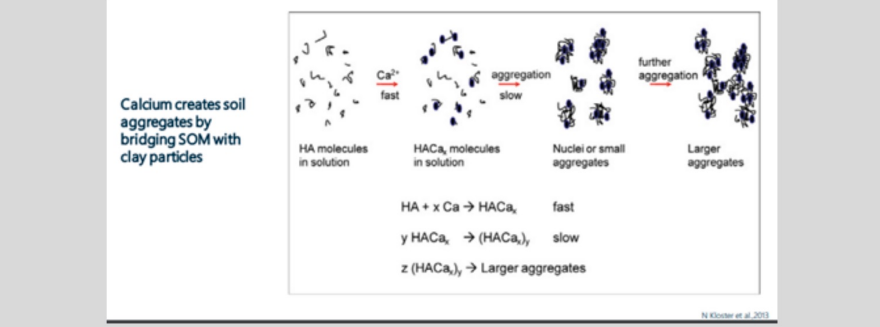
Soil contains large quantities of Calcium. Humic Acids (HA) with high Cation Exchange Capacity (CEC) values provide Calcium ions on those negatively charged sites and even form a complex to prevent them from leaching. One of the most important interactions between Humic Acids and Calcium is the way they cooperate to create soil aggregates (see picture below). Also, HA and Ca will form HA-Ca complex in soil solution. The HA-Ca complexes improved the utilization of calcium increasing the calcium content in plants, promoting root development and growth (For Chelating and absorption mechanism’ for more information
(https://www.sciencedirect.com/science/article/pii/S0147651322003426)