Humic Acids and Nitrogen
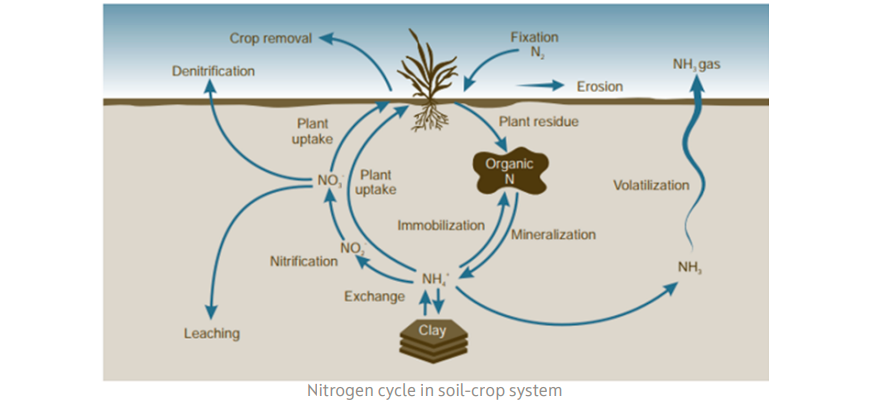
Urea, which is the most widely used synthetic nitrogenous (N) fertilizer globally, comes in the form of organic nitrogen which cannot be absorbed by plants, since they can only directly take inorganic forms of nitrogen, ammonium (NH₄⁺) or nitrate (NO3-). When applying urea to the soil, it goes through the ammonia process, where the ammonium is hydrolyzed. This process is regulated by urease; enzyme that catalyzes the hydrolysis of urea, forming ammonia and carbon dioxide.
Ammonium has four routes of action in the soil:
1. Loss on volatilization under alkaline conditions and exposure to the atmosphere. For example, in tillage.
2. Temporary loss due to immobilization, when returning to organic Nitrogen.
3. Loss on nitrification, the natural oxidation of ammonia to nitrite followed by oxidation of nitrite to nitrate, which is regulated by certain microbes and the initial soil ammonium concentrations.
4. Uptake by the plant.
The incorporation of Humic Substances inhibits urease activity and reduces the initial ammonium concentration during the hydrolysis process in the first weeks after application. The lower the ammonium concentration, the lower the nitrification, resulting in a significant decrease in nitrogen leaching. Humic substances have a high value of both Cation Exchange Capacity (CEC) and Anion Exchange Capacity (AEC), 200-300meq/100g and 250-275meq/100g respectively. These are directly associated with humins, the insoluble fraction of humic substances. The CEC is responsible for containing the ammonium to reduce its possible loss by volatilization. While the AEC helps with the containment of nitrate, decreasing its loss by leaching.
Humic substances increase the reserve of organic nitrogen in the soil. Humic applications promote microbiology, in particular, beneficial fungal and bacterial populations that help to accumulate organic nitrogen in the soil. By stimulating populations of nitrogen-fixing bacteria and increasing the total biomass of crop residues that are ultimately broken down into sugars and amino acids to boost the organic nitrogen pool. The addition of humic substances facilitates the reduction of organic nitrogen, releasing inorganic nitrogen much faster. An effective test is the Sugar Amino Nitrogen Test or ISNT test. This measures the total amount of organic nitrogen in the soil profile.