The Importance of Organic Carbon in the Soil
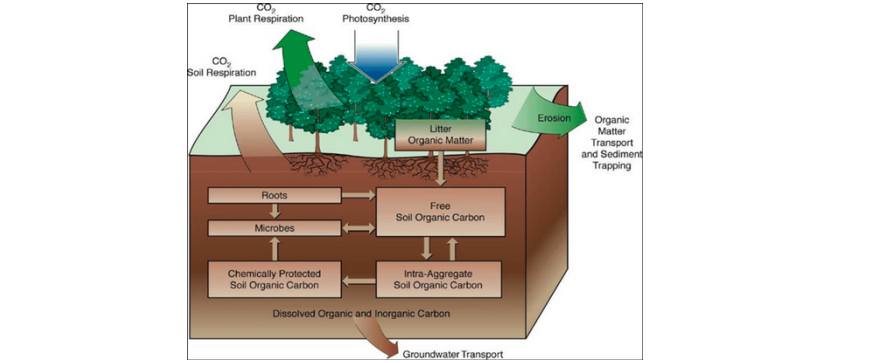
Soil carbon content can be a direct measure of soil health. The carbon emission resulting from climate change and its detrimental effects on the environment has given rise to research focused on carbon sequestration in the soil. Given the importance of this issue, multiple investigations have been generated related to the fundamental role that soil has as a reserve and potential carbon fixer to minimize negative effects on the environment. However, the importance of the carbon element is closely linked to the quality and fertility of soils in general since this compound is the quintessential base of organic compounds, which are essential in the soil.
The formation of the soil itself is associated with the interaction of organic matter with the parent or mineral material, which initiates its formation, and it is that you cannot think of soil without the presence of organic matter, which of course it is made up of carbonated compounds.
When we talk about Organic Carbon, we refer to all the compounds in different forms and structures that we can find in soil; these compounds are part of the organic matter found in it and are in a constant process of transformation, product of microbiological activity. For this reason, when we talk about organic carbon, we refer to all those organic compounds in different forms.
In natural and stable soil, we find different groups of compounds with a carbon element; initially, we can classify them into two large groups, those that are part of living organic matter and those that are part of dead organic matter in the process of humification.
Living organic matter is in the soil and is part of all the macro and microfauna of the soil. There is a constant evolution and transformation; this great macro and microbial mass are responsible for the health of the soil and the microbiological balance in a healthy soil that allows plant growth, whether on farms, ornamental plants, gardening, grass, etc. But later in another article, we will delve deeper into this microbiological topic.
Dead organic matter comprises all plant, animal, and microbiological tissues that die and are in different stages of the destruction process. These compounds in the transformation process provide different nutrients to plants and microorganisms that inhabit the soil. These compounds also develop reactions at the soil level that contribute to the solubilization of minerals, making them available to plants and microorganisms.
The microbiological activity is transforming all these carbon compounds into simpler compounds, the ecosystem uses these compounds, and most of them are lost in the environment; only a small amount undergoes humification processes that produce increasingly stable substances, which adhere to the clays of the soil, these compounds are known as humic substances. These humic substances are responsible for many soil properties and are the basis of soil fertility. They are carbon compounds united in chains of much more stable structures with positive and negative electrical charges; this property is responsible for the reaction, solubilization, and availability of soil minerals so that they can be used by all living beings that inhabit the soil. That ecosystem. These forms of carbon are constituted as the reserve bank of structural organic matter that the soil has or also known as structural organic carbon of the soil.
Humic substances are classified into humic acids, fulvic acids, hymatomelanic acids, and humins; dilution processes separate each in an alkaline extraction, then in acid media and alcohols. Humic substances are essential in the soil’s many physical, chemical, and physical properties. They are involved in the cation exchange capacity, mineralization processes, acidity neutralization, microbiology stimulation, root system stimulation, activation of plant systemic resistance mechanisms, and water retention processes in soils.
Humic acids and humins are the most stable compounds and with the highest molecular weight; for this reason, they are the compounds that contribute the most to increasing the structural organic carbon in the soil and increasing that reserve bank that gives it fertility.
Although humic acid fractions are naturally decomposable, their decomposition is slow, resulting in a constant supply of Carbon to the soil. Our Black Earth products contain a large amount of Carbon in humic forms; this indicates that the application of our products provides additional Carbon to soil microorganisms, which is essential for soil biological activities.
The multiple benefits of increasing the carbon content in the form of humic acids are translated into more fertile soil that benefits the activity in which you use the soil, be it agriculture, livestock, gardening, or grass. These effects are more appreciable in activities where, due to the intensity of the exploitation, the soils have been degraded, mobilized, eroded, intoxicated, and flattened.